The Real Cost Of Hosting Twenty People In Your Backyard
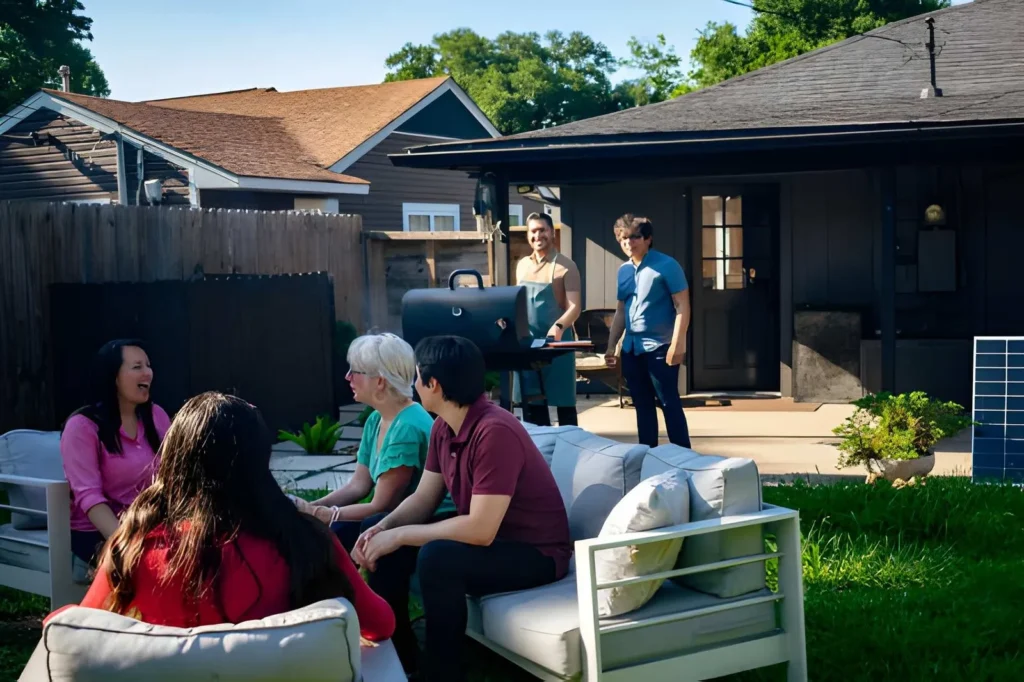
Dana counted twenty-two people in her Glen Allen backyard last October, and eleven of them were standing. Four folding tables sat out on grass that had not dried since the morning rain. She had run that same scene six weekends a year for three seasons before she finally called deck builders richmond va and asked the only question that actually mattered, which was how much deck twenty guests need before somebody ends up eating a plate of ribs standing over the cooler. Sizing and material are the two numbers that decide what a hosting deck really costs. Everything after those two is trim.
Crowd Size Sets Square Footage Before Style
Start with bodies, not with railing profiles. A standing guest holding a drink takes up roughly ten to fifteen square feet once you subtract the space nobody actually stands in, meaning the grill zone, the door swing, and the corner where the cooler always ends up. Seated dining wants closer to twenty-five per person. Twenty guests, mostly on their feet, with one table of eight who will not move all evening, lands somewhere near three hundred square feet of usable surface, which is exactly why sixteen by twenty keeps turning up on estimates written for people who host at this scale.
The pattern we see most often is a deck sized to the household instead of to the guest list. Fine for four on a Tuesday. Short by half the second twenty people arrive carrying side dishes. The tape measure doesn’t negotiate, and neither does a folding table on wet grass.
Running The Numbers On Sixteen By Twenty
Run one scenario start to finish and the ceiling stops being abstract. Say a sixteen by twenty deck, which is 320 square feet, built in a mid-grade composite at a hypothetical $48 per square foot installed: that puts the deck surface and framing at $15,360. Add a $250 county permit, $900 for a four-step stair run down to the lawn, and $600 for low-voltage stair and post lighting so nobody finds the bottom step with a shin. That scenario comes to $17,110 all in, roughly $2,900 under a twenty thousand dollar ceiling.
What eats the cushion is almost never the decking itself. Permit fees move county to county, an HOA architectural review can add three weeks and a drawing set before anything gets ordered, and a yard with a two foot drop across twenty feet needs footings that the flat-yard estimate never priced in. The deck builders richmond va homeowners keep calling back are the ones who walk the grade before quoting, because the ground under the deck decides more of the framing budget than the finish on top of it ever will.
Material Choice Moves The Total Most
Sizing is arithmetic. Material is where the budget genuinely swings.
Pressure-treated pine is the cheap entry and the expensive decade: low up front, then sanding and sealing every couple of seasons, plus boards that cup and check in Central Virginia humidity. Cedar sits in the middle and looks the part for a good while. Composite lines like Trex and TimberTech cost more per board and hand the weekends back, which matters when the entire point of the build is the six weekends you spend on the deck rather than under it with a sander. On a 320 square foot surface, a $12 per square foot spread between two materials is a $3,840 swing, bigger than the stairs, the lighting and the permit added together in the scenario above.
The way people budget a weekly dessert run is a useful comparison here. Nobody flinches at a twenty dollar box of cookies on a Friday night, and yet fifty-two Fridays is over a thousand dollars a year that never appears as a line item anywhere. Decking runs the other direction. One large visible number up front, then either near-zero upkeep or a recurring stain-and-seal habit that hides in the same blind spot the cookie budget lives in. Composite front-loads the pain, wood spreads it out and quietly assumes you are not keeping score.
Cost Per Gathering Beats Cost Per Square Foot
Cost per square foot is the number contractors quote, and it is the wrong number for a host to optimize. Divide by gatherings instead. That $17,110 scenario, spread across six gatherings a year for ten years, works out to about $285 a gathering, which is less than catering two of them properly. (Yes, that ignores resale value and the awkward fact that you will start hosting more often once there is room, but the direction is right.)
The wider market points at sizing and material rather than at fixtures and finishes. A July 2026 rundown from Fun Outdoor Living put the average outdoor entertaining space at $7,800, with the deck portion of those entertaining projects averaging $8,300 installed, which says two things at once. A deck built for real crowds sits well above the average outdoor project. And the distance between $8,300 and a $17,000 build is mostly square footage and material, not luxury.
So work the order that matches the money. Guest count first, honest square footage second, material chosen against the maintenance calendar you will realistically keep third. Permits and HOA drawings are a scheduling problem rather than a budget problem, as long as somebody owns them before the lumber arrives. Get those in the right sequence and the folding tables stay in the garage, which is where they have wanted to be for three seasons.